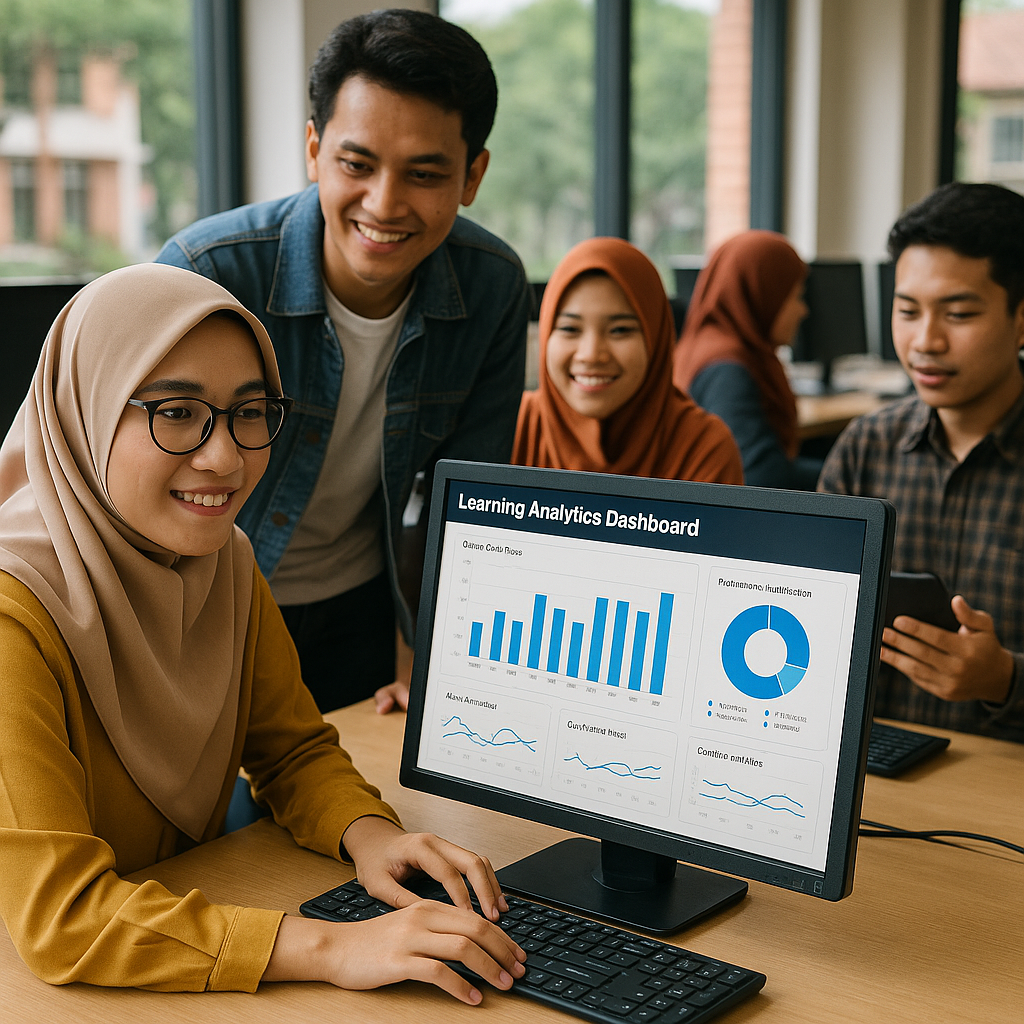
Adoption of AI-Based Learning Analytics to Support Academic Decision-Making in Universities
DOI:
https://doi.org/10.62012/jostem.vi.28Keywords:
AI-based learning analytics, academic decision-making, digital transformation, higher education management, institutional readiness, predictive analytics, educational data miningAbstract
This study examines the adoption of AI-based learning analytics and its role in supporting academic decision-making in universities. As higher education institutions face increasing demands for accountability and data-driven governance, AI-enabled analytics offer new opportunities to monitor student performance, identify risk patterns, and improve instructional quality. Using a mixed-methods design, the research collected survey responses from 261 academic staff and conducted interviews with 15 university leaders. Findings show that most respondents perceive AI-based analytics as highly useful for early identification of at-risk learners, curriculum refinement, and accreditation reporting. Institutional readiness particularly digital infrastructure, staff competence, and leadership support significantly influences the extent of analytics utilization. Qualitative insights reveal that ethical concerns, cultural resistance, and integration challenges remain major barriers to adoption. The study concludes that successful implementation requires not only technological investment but also strategic leadership and clear governance frameworks to ensure responsible and effective use of analytics. These results contribute to ongoing discussions on digital transformation in higher education and highlight the organizational conditions necessary to leverage AI-driven insights for improving academic planning and student outcomes.
Downloads
References
G. Siemens and P. Long, “Penetrating the fog: Analytics in learning and education,” Educause Review, vol. 46, no. 5, pp. 30–40, 2011.
R. S. Joksimović et al., “How do we model learning? A review of machine learning approaches to learning analytics,” IEEE Trans. Learn. Technol., vol. 12, no. 3, pp. 333–353, 2019.
S. Salsabilah, “The role of accountability in the implementation of the curriculum policy (2013) in secondary school”, Jostem, vol. 1, no. 1, pp. 12–16, May 2024.
C. Romero and S. Ventura, “Educational data mining and learning analytics: An updated survey,” WIRES Data Mining & Knowledge Discovery, vol. 10, no. 3, 2020.
A. Alammary, “Blended learning models for higher education: A critical review,” Int. J. Educ. Technol. High. Educ., vol. 16, 2019.
N. Chen, S. Cheng, and K. Hung, “Predicting student academic performance: A review,” IEEE Access, vol. 8, pp. 146620–146632, 2020.
J. M. Moreno, M. Redondo, and C. Fernández, “Predictive analytics in MOOCs: A review,” IEEE Trans. Learn. Technol., vol. 14, no. 3, pp. 392–404, 2021.
K. Mangaroska and M. Giannakos, “Learning analytics for learning design: A systematic review,” IEEE Trans. Learn. Technol., vol. 12, no. 4, pp. 516–542, 2019.
A. M. Ifenthaler and D. Yau, “Utilizing learning analytics to support study success in higher education,” Br. J. Educ. Technol., vol. 51, no. 5, pp. 1205–1221, 2020.
S. Joksimović et al., “Predictive modelling in education,” in Proc. LAK 2020, pp. 537–546.
S. Papamitsiou and A. Economides, “Learning analytics and educational data mining in practice,” Educ. Technol. Soc., vol. 17, no. 4, pp. 49–64, 2014.
D. Ifenthaler and J. Y. Kim, “Readiness for AI-based learning analytics,” Computers in Human Behavior, vol. 126, 2022.
D. B. Yadav and S. Pal, “Educational decision support using machine learning,” IEEE Access, vol. 9, pp. 22433–22452, 2021.
R. Ferguson, “Learning analytics: Drivers, developments, and challenges,” Int. J. Technol. Enhanc. Learn., vol. 4, no. 5, pp. 304–317, 2012.
UNESCO, AI and Education: Guidance for Policy-Makers. Paris: UNESCO Publishing, 2021.
U. M. Gappa, “Development Of Learning Devices Of Direct Teaching Model For Grade Vii Students On The Concept Of Quadrangles ”, Jostem, vol. 1, no. 2, pp. 53–66, Nov. 2024.
A. Mavroudi and D. Giannakos, “Adoption of learning analytics in higher education,” Br. J. Educ. Technol., vol. 53, no. 2, pp. 423–440, 2022.
J. M. Wing, “Trustworthy artificial intelligence: A pressing challenge for education data,” Commun. ACM, vol. 64, no. 10, pp. 67–75, 2021.
C. K. Lo, “A review of ethical concerns of learning analytics in higher education,” Educ. Technol. Res. Dev., vol. 69, pp. 1301–1322, 2021.
S. Pardo and G. Siemens, “Ethical and privacy considerations in learning analytics,” in Handbook of Learning Analytics, 2nd ed., SoLAR, 2022.
Y. M. Safarudin, “Thinking Profile Of Junior High School Students In Understanding The Concept Of Quadrangles With Linguistic Intelligence, Logical-Mathematical Intelligence, And Visual-Spatial Intelligence ”, Jostem, vol. 1, no. 2, pp. 67–79, Nov. 2024.
A. Sibanda and L. Donnelly, “The role of leadership in adopting learning analytics in higher education,” Stud. High. Educ., vol. 47, no. 5, pp. 1023–1038, 2022.
M. F. B. Yusup, “Challenges and Solutions in Improving School Infrastructure in Remote Areas”, Jostem, vol. 1, no. 2, pp. 27–32, Nov. 2024.
M. Ifenthaler and J. Y. Kim, “AI-supported academic advising: Opportunities and challenges,” Internet and Higher Education, vol. 52, 2022.