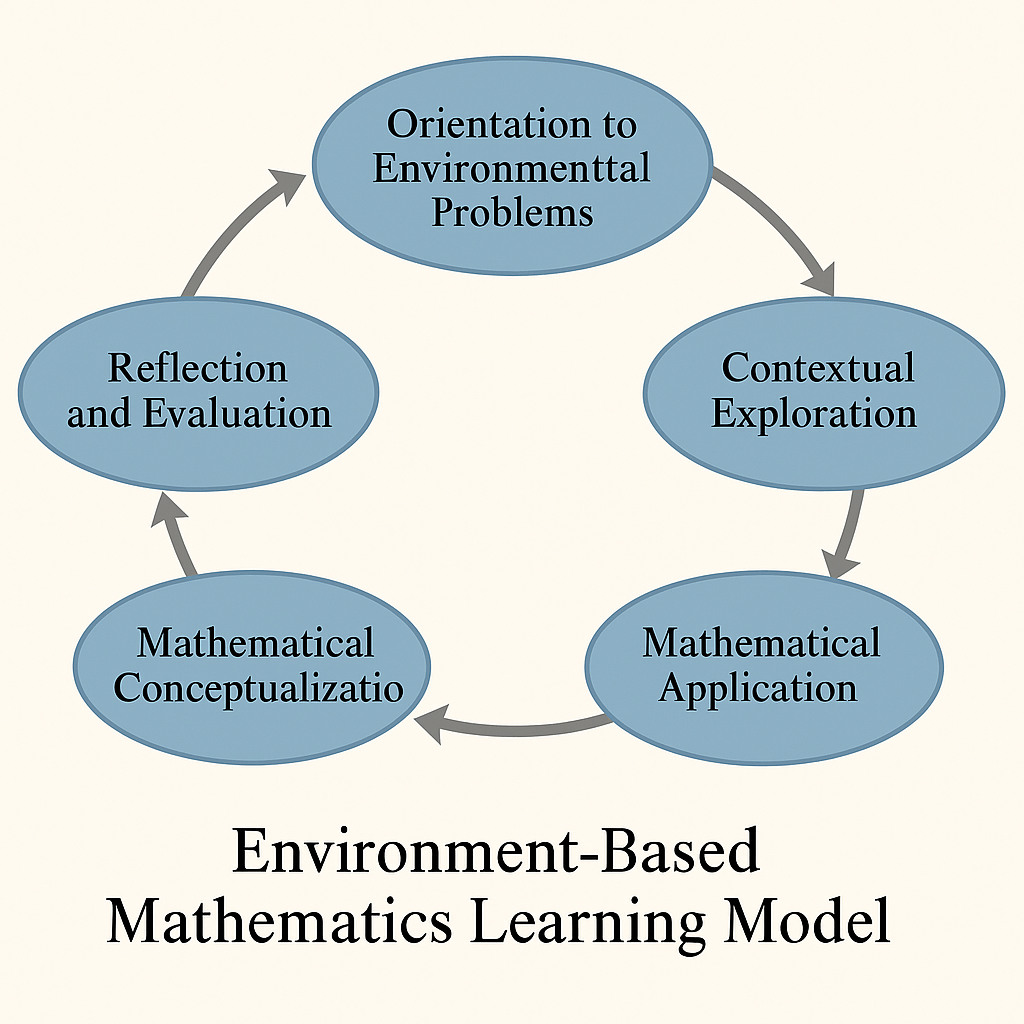
Transformational Learning Design: Developing an Environment-Based Mathematics Model for Quality and Outcome Improvement
DOI:
https://doi.org/10.62012/jostem.vi.30Keywords:
environment-based learning, mathematics education, transformational learning design, learning quality, outcome improvement, contextual instructionAbstract
This study develops and evaluates the Environment-Based Mathematics Learning (EBML) model as a transformational instructional approach to improve learning quality and outcomes in secondary mathematics. The model integrates environmental exploration, contextual problem-solving, and collaborative inquiry to strengthen students’ conceptual understanding. Using a developmental research design, EBML was validated through expert assessments, classroom observations, student responses, and pre–post learning performance. The validation results show a high level of conceptual and structural validity (average score 3.72), while practicality tests indicate strong acceptance among teachers (90.63%) and students (92.16%). Effectiveness analysis demonstrates significant improvement in learning outcomes, with achievement increasing from 62.06% to 87.79% and a gain index of 0.68. Student activity also remained consistently high across all learning stages. The findings confirm that EBML is a feasible, effective, and contextually rich model that transforms mathematics learning by connecting abstract concepts to meaningful environmental experiences.
Downloads
References
J. A. López and F. J. P. Palacios, “Effects of a Project-Based Learning Methodology on Environmental Awareness of Secondary School Students,” International Journal of Instruction, p., 2024, doi: 10.29333/iji.2024.1711a.
C. Ssali, M. S. K. Batiibwe, B. Dahl, H. A. Kariisa, J. Magero, and G. Mayende, “Problem-based learning in secondary school mathematics: a review,” Educational Research, vol. 67, pp. 212–230, 2025, doi: 10.1080/00131881.2025.2493255.
I. Supianti, P. Yaniawati, E. Bonyah, A. W. Hasbiah, and N. Rozalini, “STEAM approach in project-based learning to develop mathematical literacy and students’ character,” Infinity Journal, p., 2025, doi: 10.22460/infinity.v14i2.p283-302.
M. Chhabra and A. Gawande, “How does project-based-learning makes difference in secondary school mathematics,” Multidisciplinary Science Journal, p., 2025, doi: 10.31893/multiscience.2025550.
A. Solihin, N. Mariana, W. Wiryanto, I. Rahmawati, and S. Suryanti, “Integrating Ethnomathematics of Zero Waste Culture Based ESD to Enhance Students’ Creative Thinking and Sustainability Consciousness,” Journal of Innovation and Research in Primary Education, p., 2025, doi: 10.56916/jirpe.v4i2.1221.
I. Yani, S. Budiana, T. Rostikawati, F. S. Sundari, M. Afifuddin, and K. Umam, “Enhancing Students’ Pollution Problem-Solving Skills Through Problem-Based Learning: The Moderating Role of Mathematical Literacy,” Journal of Mathematics Instruction, Social Research and Opinion, p., 2025, doi: 10.58421/misro.v4i2.431.
V. Bermejo, P. Ester, and I. Morales, “A Constructivist Intervention Program for the Improvement of Mathematical Performance Based on Empiric Developmental Results (PEIM),” Front Psychol, vol. 11, p., 2021, doi: 10.3389/fpsyg.2020.582805.
N. Rehman, X. Huang, A. Mahmood, M. AlGerafi, and S. Javed, “Project-based learning as a catalyst for 21st-Century skills and student engagement in the math classroom,” Heliyon, vol. 10, p., 2024, doi: 10.1016/j.heliyon.2024.e39988.
I. Risdiyanti, Zulkardi, R. Ilma, I. Putri, R. Charitas, and I. Prahmana, “Mathematical literacy learning environment for inclusive education teachers: A framework,” Journal on Mathematics Education, p., 2024, doi: 10.22342/jme.v15i3.pp1003-1026.
A. Ilhan, “The Impact of Game-Based, Modeling, and Collaborative Learning Methods on the Achievements, Motivations, and Visual Mathematical Literacy Perceptions,” Sage Open, vol. 11, p., 2021, doi: 10.1177/21582440211003567.
Y. H. Fakhruddin, Nurjanah, and B. Martadiputra, “The Impact of Problem-Based Learning on Mathematics Education: A Systematic Literature Review,” EDUTEC : Journal of Education And Technology, p., 2025, doi: 10.29062/edu.v8i3.1112.
F. Andini and M. A. P. Siregar, “The effect of problem based learning on students’ mathematical literacy ability,” Desimal: Jurnal Matematika, p., 2024, doi: 10.24042/djm.v7i1.22211.
E. Corte, “Fostering cognitive growth: A perspective from research on mathematics learning and instruction,” Educ Psychol, vol. 30, pp. 37–46, 1995, doi: 10.1207/s15326985ep3001_4.
R. A. Pratama and T. Yelken, “Effectiveness of ethnomathematics-based learning on students’ mathematical literacy: a meta-analysis study,” Discover Education, p., 2024, doi: 10.1007/s44217-024-00309-1.
R. Hayati, R. Marfilinda, W. Prima, S. Wulandari, and Z. Oktama, “Perancangan model Holistic Mathematics Education (HME) berbasis pendekatan Realistic Mathematics Education (RME) pada siswa sekolah dasar (SD) kelas tinggi,” Borobudur Educational Review, p., 2025, doi: 10.31603/bedr.12989.
M. Ahsan, A. N. Cahyono, and I. Kharisudin, “Designing digital math trail environment assisted by augmented reality using mathematical modeling learning approach,” ELECTRONIC PHYSICS INFORMATICS INTERNATIONAL CONFERENCE (EPIIC) 2023, p., 2024, doi: 10.1063/5.0215762.
Z. Zulyadaini, “Development of teaching materials in numerical methods,” vol. 8, pp. 28–38, 2020, doi: 10.32919/uesit.2020.01.03.
N. Setyaningsih, S. Rejeki, and N. Ishartono, “Developing Realistic and Child-friendly Learning Model for Teaching Mathematics,” JRAMathEdu (Journal of Research and Advances in Mathematics Education), p., 2019, doi: 10.23917/jramathedu.v4i2.8112.
R. Chatib, A. Fauzan, I. Arnawa, and L. Lufri, “Designing Mathematics Learning Models Based on Realistic Mathematics Education and Literacy,” J Phys Conf Ser, vol. 1471, p., 2020, doi: 10.1088/1742-6596/1471/1/012055.
F. Zahra, M. Masniladevi, R. Andika, and Y. Ningsih, “Pengaruh Model Problem Based Learning (PBL) terhadap Hasil Belajar Peserta Didik Kelas V SD pada Materi Keliling Bangun Datar,” TSAQOFAH, p., 2025, doi: 10.58578/tsaqofah.v5i4.6605.
M. Saleh, K. Asri, and N. Vembera, “Reviving Algebra: Enhancing Student Outcomes Through Discovery Learning in Secondary Education,” AlphaMath : Journal of Mathematics Education, p., 2025, doi: 10.30595/alphamath.v11i1.19532.
D. W. Nurlaili, Zurweni, and Syaiful, “The Effect of Inquiry and Problem-Based Learning Models on Understanding of Mathematics Concepts Viewed from Student Learning Motivation,” Asian Journal of Education and Social Studies, p., 2023, doi: 10.9734/ajess/2023/v48i21054.
C. Lo and K. Hew, “Student Engagement in Mathematics Flipped Classrooms: Implications of Journal Publications From 2011 to 2020,” Front Psychol, vol. 12, p., 2021, doi: 10.3389/fpsyg.2021.672610.
D. G. Abdissa, G. Duressa, T. Olkaba, and E. G. Feyissa, “EFFECT OF BLENDED LEARNING EDUCATIONAL MODEL ON SECONDARY SCHOOL STUDENTS’ MATHEMATICS CONCEPTUAL UNDERSTANDING,” Problems of Education in the 21st Century, p., 2024, doi: 10.33225/pec/24.82.585.
I. Magdalena, N. F. Fadhillahwati, R. Amalia, and S. Farhana, “IMPROVING MATHEMATICS LEARNING OUTCOMES THROUGH PROBLEM BASED LEARNING (PBL) LEARNING MODEL FOR 4TH GRADE STUDENTS,” ROMEO REVIEW OF MULTIDISCIPLINARY EDUCATION CULTURE AND PEDAGOGY, p., 2023, doi: 10.55047/romeo.v2i2.692.
N. Lethulur, D. Juandi, and J. Dahlan, “The Effectiveness of Discovery, Inquiry, Problem, and Project-Based Learning in Mathematics Education: A Systematic Literature Review,” Jurnal Pendidikan MIPA, p., 2025, doi: 10.23960/jpmipa.v26i1.pp268-279.