Regional Educational Disparities in Indonesia
Evidence from Average Years of Schooling Statistics (2025)
DOI:
https://doi.org/10.62012/d8h44209Keywords:
Educational Disparities, Average Years of Schooling, Human Capital, Educational Equity, Regional DevelopmentAbstract
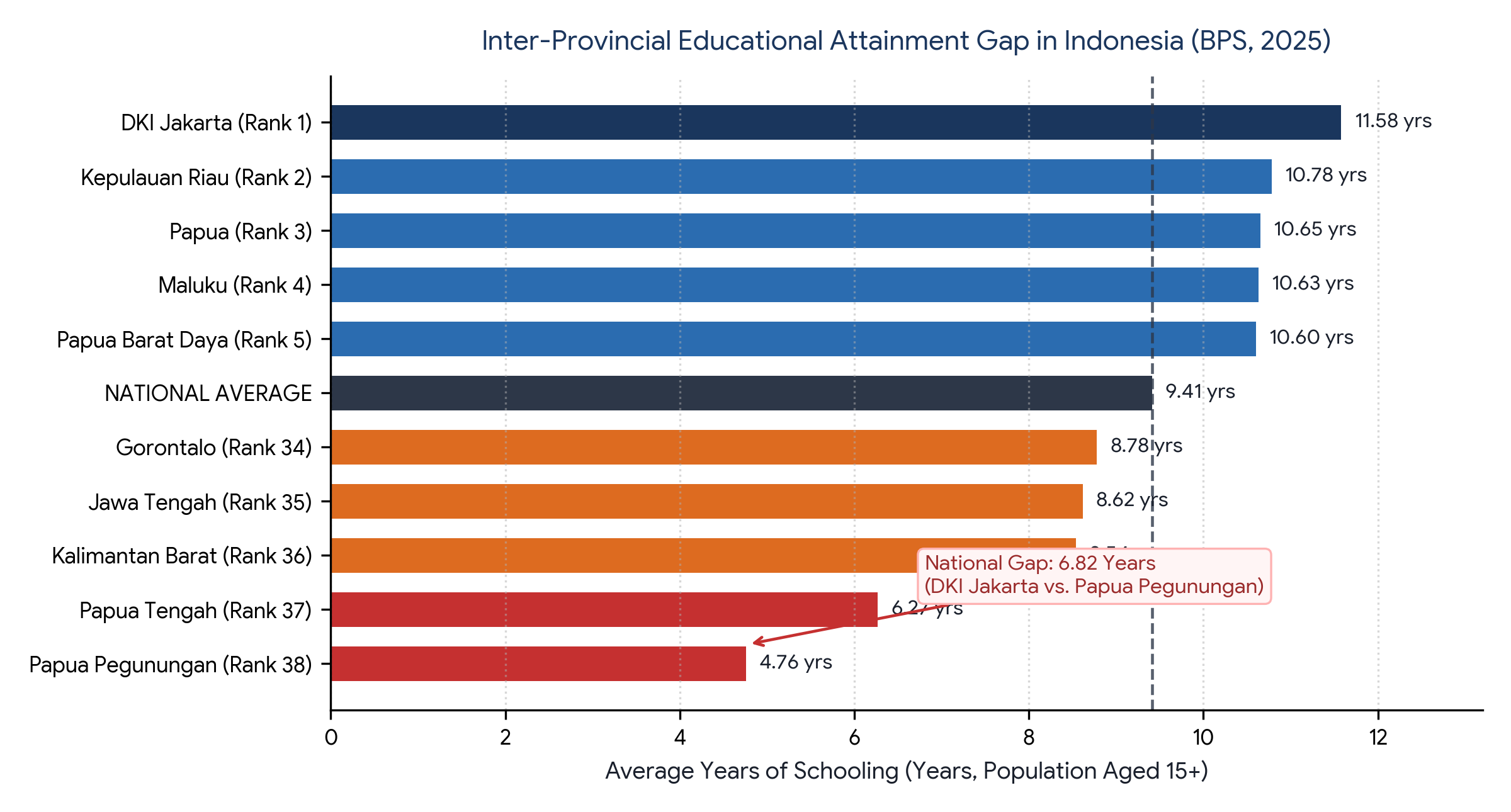
Education is a fundamental driver of human capital accumulation and inclusive socioeconomic development, yet spatial inequalities in educational attainment remain a persistent structural challenge across developing archipelagic nations. This study examines inter-provincial educational disparities across Indonesia’s 38 provinces using Average Years of Schooling (AYS) data from Education Statistics 2025 published by Statistics Indonesia (BPS). Employing a descriptive comparative quantitative design, the analysis evaluates provincial rankings, benchmark deviations against the national mean, and center–periphery attainment gaps. The results reveal pronounced spatial inequality: DKI Jakarta records the highest AYS at 11.58 years, whereas Papua Pegunungan records the lowest at 4.76 years, yielding a national attainment gap of 6.82 years around the national benchmark of 9.41 years. Notably, several non-Java provinces including Kepulauan Riau (10.78), Papua (10.65), Maluku (10.63), and Papua Barat Daya (10.60) outperform the national average, demonstrating that regional development trajectories are not strictly bound by a Java–outer-island dichotomy. The study concludes that reducing spatial educational inequality requires place-based fiscal allocation, targeted infrastructure investment, and differentiated regional governance strategies.
Downloads
References
[1] E. A. Hanushek and L. Woessmann, The Knowledge Capital of Nations: Education and the Economics of Growth. Cambridge, MA, USA: MIT Press, 2015, doi: https://doi.org/10.7551/mitpress/9780262029179.001.0001.
[2] United Nations Development Programme, Human Development Report 2023/2024: Breaking the Gridlock—Reimagining Cooperation in a Polarized World. New York, NY, USA: UNDP, 2024.
[3] G. S. Becker, Human Capital: A Theoretical and Empirical Analysis, with Special Reference to Education, 3rd ed. Chicago, IL, USA: University of Chicago Press, 1993, doi: https://doi.org/10.7208/chicago/9780226041223.001.0001.
[4] A. Sen, Development as Freedom. New York, NY, USA: Alfred A. Knopf, 1999.
[5] R. J. Barro and J. W. Lee, Education Matters: Global Schooling Gains from the 19th to the 21st Century. Oxford, UK: Oxford University Press, 2015, doi: https://doi.org/10.1093/acprof:oso/9780199379231.001.0001.
[6] World Bank, World Development Report 2018: Learning to Realize Education’s Promise. Washington, DC, USA: World Bank, 2018, doi: https://doi.org/10.1596/978-1-4648-1096-1.
[7] UNESCO, Reimagining Our Futures Together: A New Social Contract for Education. Paris, France: UNESCO, 2021, doi: https://doi.org/10.54675/ASRB4722.
[8] OECD, Education at a Glance 2024: OECD Indicators. Paris, France: OECD Publishing, 2024, doi: https://doi.org/10.1787/c00cad36-en.
[9] Ministry of National Development Planning/BAPPENAS, Rencana Pembangunan Jangka Menengah Nasional (RPJMN) 2025–2029. Jakarta, Indonesia: BAPPENAS, 2025.
[10] Ministry of National Development Planning/BAPPENAS, Rencana Pembangunan Jangka Panjang Nasional (RPJPN) 2025–2045. Jakarta, Indonesia: BAPPENAS, 2024.
[11] Kementerian Pendidikan, Kebudayaan, Riset, dan Teknologi Republik Indonesia, Kurikulum Merdeka: Pembelajaran yang Fleksibel dan Adaptif. Jakarta, Indonesia: Kemendikbudristek, 2022.
[12] Kementerian Pendidikan Dasar dan Menengah Republik Indonesia, Statistik Persekolahan SD, SMP, SMA, dan SMK Tahun Ajaran 2024/2025. Jakarta, Indonesia: Pusdatin Kemendikdasmen, 2025.
[13] Kementerian Keuangan Republik Indonesia, Program Indonesia Pintar: Kebijakan Bantuan Pendidikan untuk Siswa Kurang Mampu. Jakarta, Indonesia: Kementerian Keuangan, 2023.
[14] Badan Pusat Statistik, Statistik Pendidikan 2025. Jakarta, Indonesia: BPS, 2025.
[15] Badan Pusat Statistik, Indeks Pembangunan Manusia 2024. Jakarta, Indonesia: BPS, 2024.
[16] Badan Pusat Statistik, Statistik Kesejahteraan Rakyat 2025. Jakarta, Indonesia: BPS, 2025.
[17] World Bank, The Promise of Education in Indonesia. Washington, DC, USA: World Bank, 2020, doi: https://doi.org/10.1596/34807.
[18] P. Barrett, A. Treves, T. Shmis, D. Ambasz, and M. Ustinova, The Impact of School Infrastructure on Learning: A Synthesis of the Evidence. Washington, DC, USA: World Bank, 2019, doi: https://doi.org/10.1596/978-1-4648-1378-8.
[19] UNESCO, Global Education Monitoring Report 2023: Technology in Education—A Tool on Whose Terms? Paris, France: UNESCO, 2023, doi: https://doi.org/10.54676/UZQV8501.
[20] OECD, PISA 2022 Results (Volume I): The State of Learning and Equity in Education. Paris, France: OECD Publishing, 2023, doi: https://doi.org/10.1787/53f23881-en.