Coding and Artificial Intelligence Education in Indonesia’s 2025 Curriculum Reform
A Document-Based Policy Analysis
DOI:
https://doi.org/10.62012/wdq32j57Keywords:
Curriculum Policy, Coding Education, Artificial Intelligence, Computational Thinking, IndonesiaAbstract
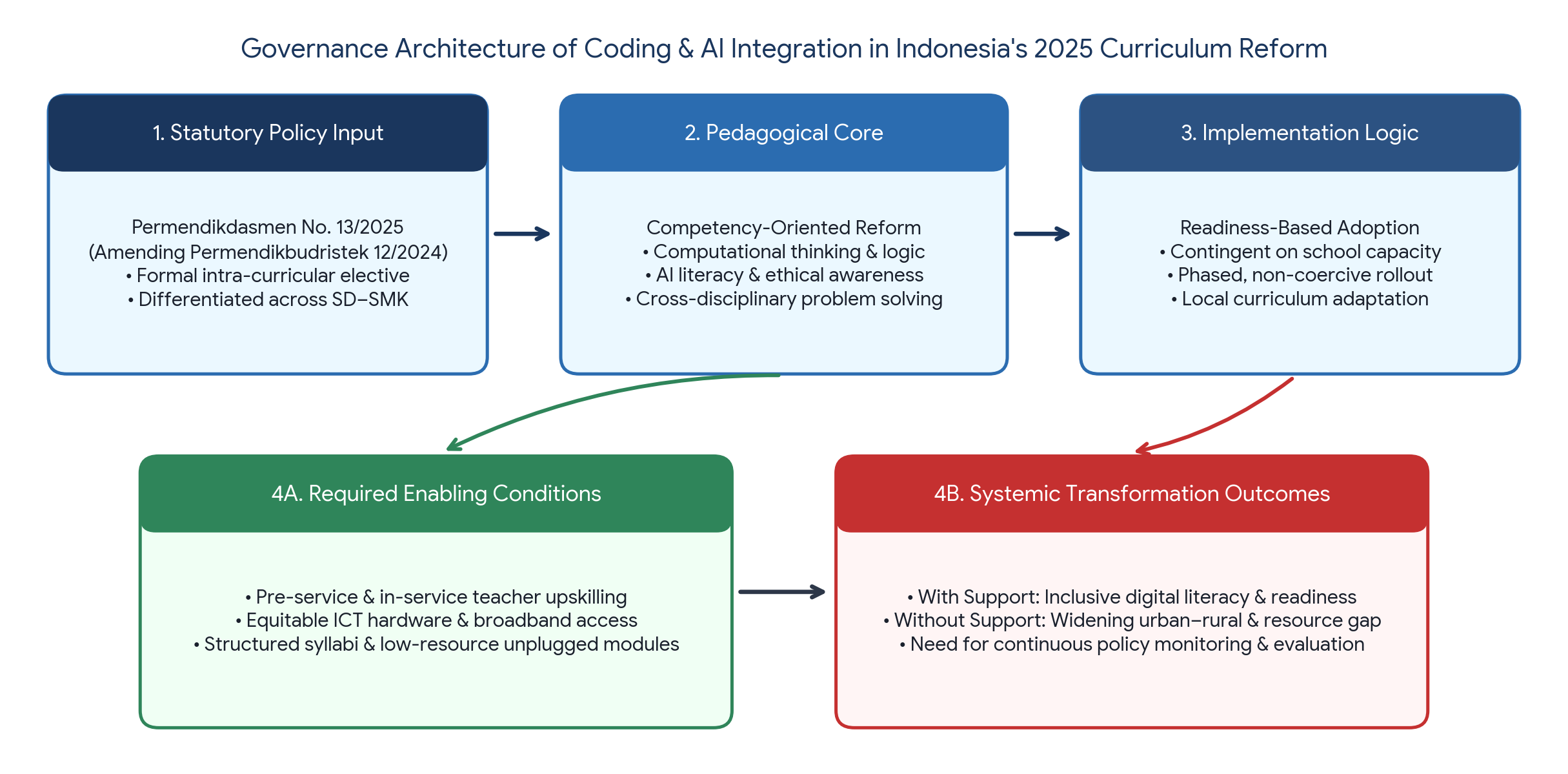
Integrating Coding and Artificial Intelligence (AI) into school curricula has become a strategic priority for preparing learners for a rapidly evolving digital society. In Indonesia, this reform is codified in the Ministerial Regulation of Primary and Secondary Education No. 13 of 2025, which introduces Coding and Artificial Intelligence as elective subjects within the national curriculum. This study analyzes the regulatory design, curricular positioning, and governance logic of this policy using qualitative document analysis of the 2025 ministerial regulation and its official annexes. The findings show that Coding and AI are formally embedded as elective subjects aimed at cultivating computational thinking, logical reasoning, problem-solving, and ethical technological literacy while accommodating diverse school readiness through phased, optional adoption. However, readiness-based flexibility risks widening digital learning disparities between well-resourced and underserved schools unless paired with targeted teacher training, computing infrastructure, and equitable resource allocation.
Downloads
References
[1] UNESCO, Global Education Monitoring Report 2023: Technology in Education—A Tool on Whose Terms? Paris, France: UNESCO Publishing, 2023, doi: https://doi.org/10.54676/UZQV8501.
[2] OECD, OECD Digital Education Outlook 2023: Towards an Effective Digital Education Ecosystem. Paris, France: OECD Publishing, 2023, doi: https://doi.org/10.1787/c74f03de-en.
[3] World Bank, Digital Technologies in Education. Washington, DC, USA: World Bank, 2024.
[4] M. Tedre and P. J. Denning, Computational Thinking. Cambridge, MA, USA: MIT Press, 2019, doi: https://doi.org/10.7551/mitpress/11740.001.0001.
[5] International Society for Technology in Education, ISTE Standards for Students. Arlington, VA, USA: ISTE, 2016.
[6] UNESCO, AI and Education: Guidance for Policy-Makers. Paris, France: UNESCO Publishing, 2021, doi: https://doi.org/10.54675/PCSP7350.
[7] European Commission, Digital Education Action Plan 2021–2027: Resetting Education and Training for the Digital Age. Brussels, Belgium: European Commission, 2020.
[8] UNICEF, Policy Guidance on AI for Children 2.0. New York, NY, USA: UNICEF, 2021.
[9] UNESCO, Guidance for Generative AI in Education and Research. Paris, France: UNESCO Publishing, 2023, doi: https://doi.org/10.54675/EWZM9535.
[10] Computer Science Teachers Association, CSTA K–12 Computer Science Standards, Revised 2017. New York, NY, USA: CSTA, 2017.
[11] L. Floridi, The Ethics of Artificial Intelligence: Principles, Challenges, and Opportunities. Oxford, U.K.: Oxford University Press, 2023, doi: https://doi.org/10.1093/oso/9780198883098.001.0001.
[12] A. Yadav, H. Hong, and C. Stephenson, “Computational thinking for all: Pedagogical approaches to embedding 21st century problem solving in K–12 classrooms,” TechTrends, vol. 60, no. 6, pp. 565–568, 2016, doi: https://doi.org/10.1007/s11528-016-0087-7.
[13] J. M. Wing, “Computational thinking,” Commun. ACM, vol. 49, no. 3, pp. 33–35, 2006, doi: https://doi.org/10.1145/1118178.1118215.
[14] S. Papert, Mindstorms: Children, Computers, and Powerful Ideas. New York, NY, USA: Basic Books, 1980.
[15] N. Selwyn, Education and Technology: Key Issues and Debates, 2nd ed. London, U.K.: Bloomsbury Academic, 2017.
[16] OECD, OECD Digital Education Outlook 2021: Pushing the Frontiers with Artificial Intelligence, Blockchain and Robots. Paris, France: OECD Publishing, 2021, doi: https://doi.org/10.1787/589b283f-en.
[17] Kementerian Pendidikan Dasar dan Menengah Republik Indonesia, Peraturan Menteri Pendidikan Dasar dan Menengah Republik Indonesia Nomor 13 Tahun 2025 tentang Perubahan atas Peraturan Menteri Pendidikan, Kebudayaan, Riset, dan Teknologi Nomor 12 Tahun 2024 tentang Kurikulum pada Pendidikan Anak Usia Dini, Jenjang Pendidikan Dasar, dan Jenjang Pendidikan Menengah. Jakarta, Indonesia: Kemendikdasmen, 2025.
[18] Kementerian Pendidikan, Kebudayaan, Riset, dan Teknologi Republik Indonesia, Peraturan Menteri Pendidikan, Kebudayaan, Riset, dan Teknologi Nomor 12 Tahun 2024 tentang Kurikulum pada Pendidikan Anak Usia Dini, Jenjang Pendidikan Dasar, dan Jenjang Pendidikan Menengah. Jakarta, Indonesia: Kemendikbudristek, 2024.
[19] World Economic Forum, Schools of the Future: Defining New Models of Education for the Fourth Industrial Revolution. Geneva, Switzerland: World Economic Forum, 2020.
[20] World Economic Forum, The Future of Jobs Report 2025. Geneva, Switzerland: World Economic Forum, 2025.